
CORPORATE GOVERNANCE AND ORGANIZATIONAL ARCHITECTURE
AD³PR
FROM STRUCTURAL DIAGNOSIS TO DECISION-RELEVANT INSIGHT
Organizations rarely fail in a single moment. Problems develop, interact, stabilize, and change over time.
AD³PR provides a structured diagnostic cycle for examining how an organizational condition emerged, what competing explanations remain plausible, how the system is likely to develop, and whether earlier findings remain valid after time or intervention.
The objective is not to prescribe action prematurely. It is to create a sufficiently reliable diagnostic basis for deciding what should happen next.


WHY A SINGLE DIAGNOSIS IS NOT ENOUGH
A structural finding is only useful if the reasoning behind it can be reconstructed.
Similar symptoms may originate from different causes. Conditions may also change over time, interventions may produce unintended effects, and an initially plausible explanation may later require revision.
AD³PR therefore treats diagnosis as a controlled cycle rather than a one-time conclusion.
Diagnosis is not a snapshot. It is a disciplined process of explanation, projection, and reassessment.
HOW THE AD³PR CYCLE WORKS
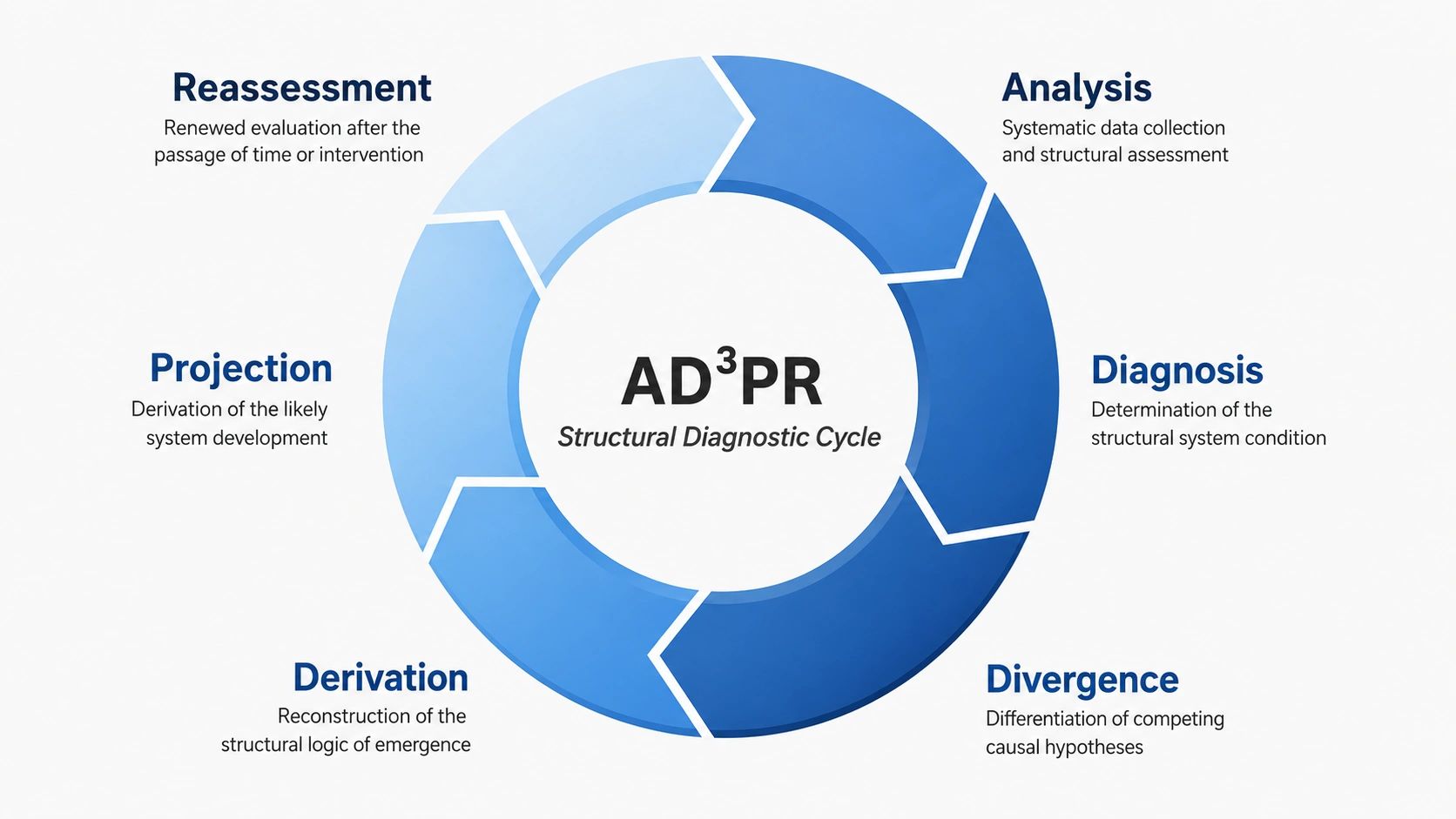
AD³PR connects six diagnostic stages into a continuous cycle.
Analysis establishes the evidence base and defines the system under review.
Diagnosis determines the structural condition of the organization.
Divergence separates competing causal explanations and distinguishes symptoms from causes.
Derivation reconstructs how the current condition developed over time.
Projection assesses the likely future development of the system if no intervention occurs.
Reassessment tests earlier findings against subsequent developments and revises the diagnostic basis where necessary.
Together, these stages create a disciplined sequence from observation to diagnosis, from diagnosis to explanation, and from explanation to decision-relevant insight.
The cycle is designed to reduce premature conclusions and to keep diagnosis, causation, projection, and reassessment analytically distinct.
WHAT AD³PR CHANGES FOR DECISION-MAKERS
Executives often face pressure to act before the underlying problem has been sufficiently understood.
AD³PR creates a disciplined barrier between pressure to intervene and evidence sufficient to justify intervention.
- reduces the risk of acting on the wrong cause;
- separates symptoms from structural drivers;
- makes competing explanations explicit;
- reconstructs how the current situation emerged;
- identifies likely consequences of non-intervention;
- creates a documented basis for management and governance decisions;
- allows earlier conclusions to be tested against subsequent developments.
The purpose is not slower decision-making. It is better-founded decision-making.
APPLIED GOVERNANCE AND ORGANIZATIONAL DIAGNOSTICS
Meridian Endeavors approaches governance as an applied organizational discipline.
Applied Governance means translating governance principles into usable diagnostic structures, decision architectures, control mechanisms, and organizational systems.
Within this approach, EFPUA provides the structural diagnostic framework, while AD³PR provides the diagnostic cycle through which evidence, diagnosis, differential analysis, causal reconstruction, projection, and reassessment are systematically connected.
Together, they create a structured bridge between understanding an organizational system and making defensible decisions about what should or should not be changed.
WHAT AD³PR IS - AND WHAT IT IS NOT
AD³PR is a structured diagnostic cycle for the investigation of organizational systems.
It supports evidence gathering, structural diagnosis, differential analysis, causal reconstruction, projection, and reassessment.
It does not prescribe a predetermined intervention and does not assume that every diagnosed condition requires organizational change. Intervention remains a separate decision based on the diagnostic findings and the circumstances of the organization.